Benchtop 532nm Raman spectrometer: High sensitivity & modular microspectroscopy
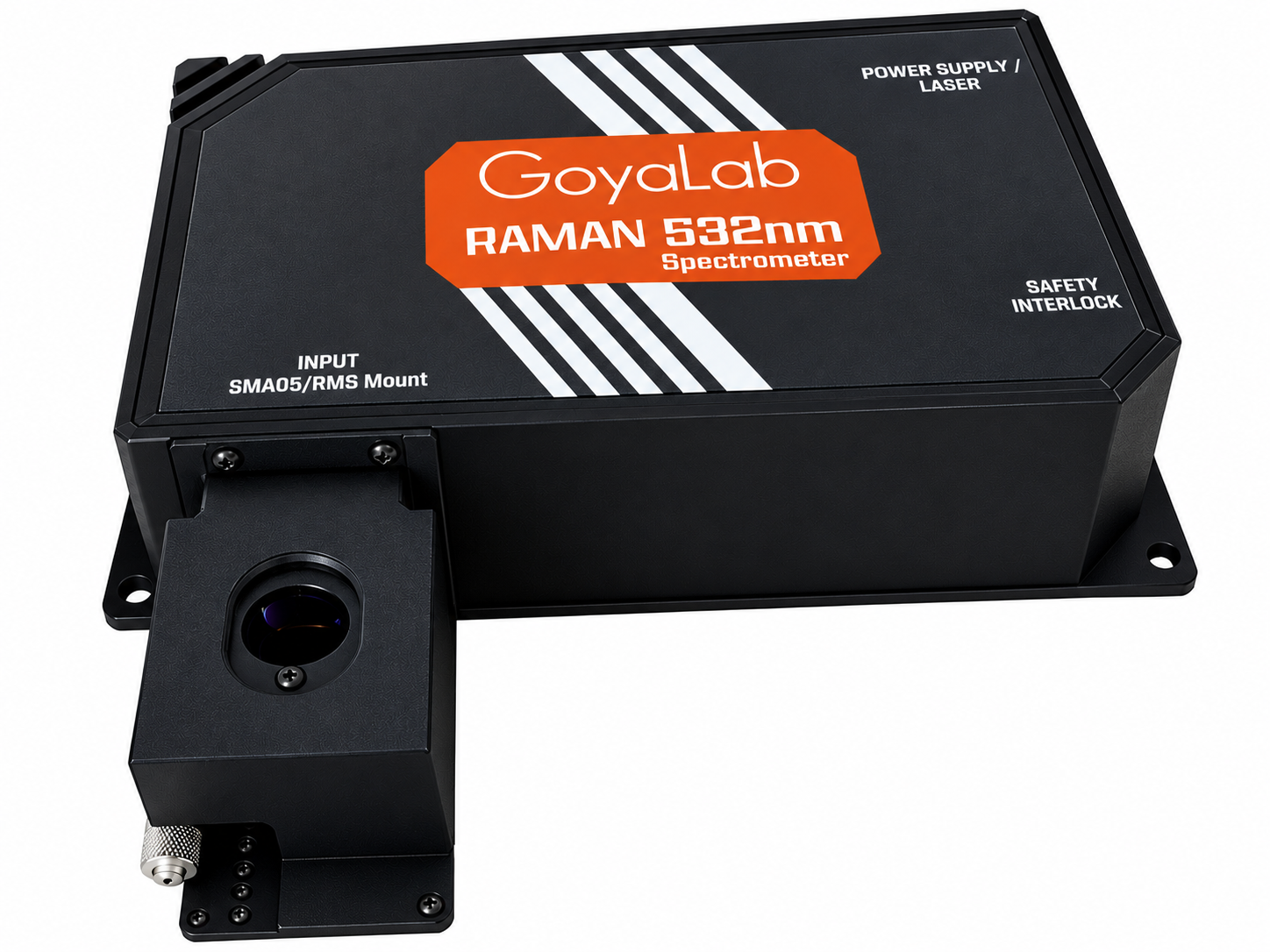
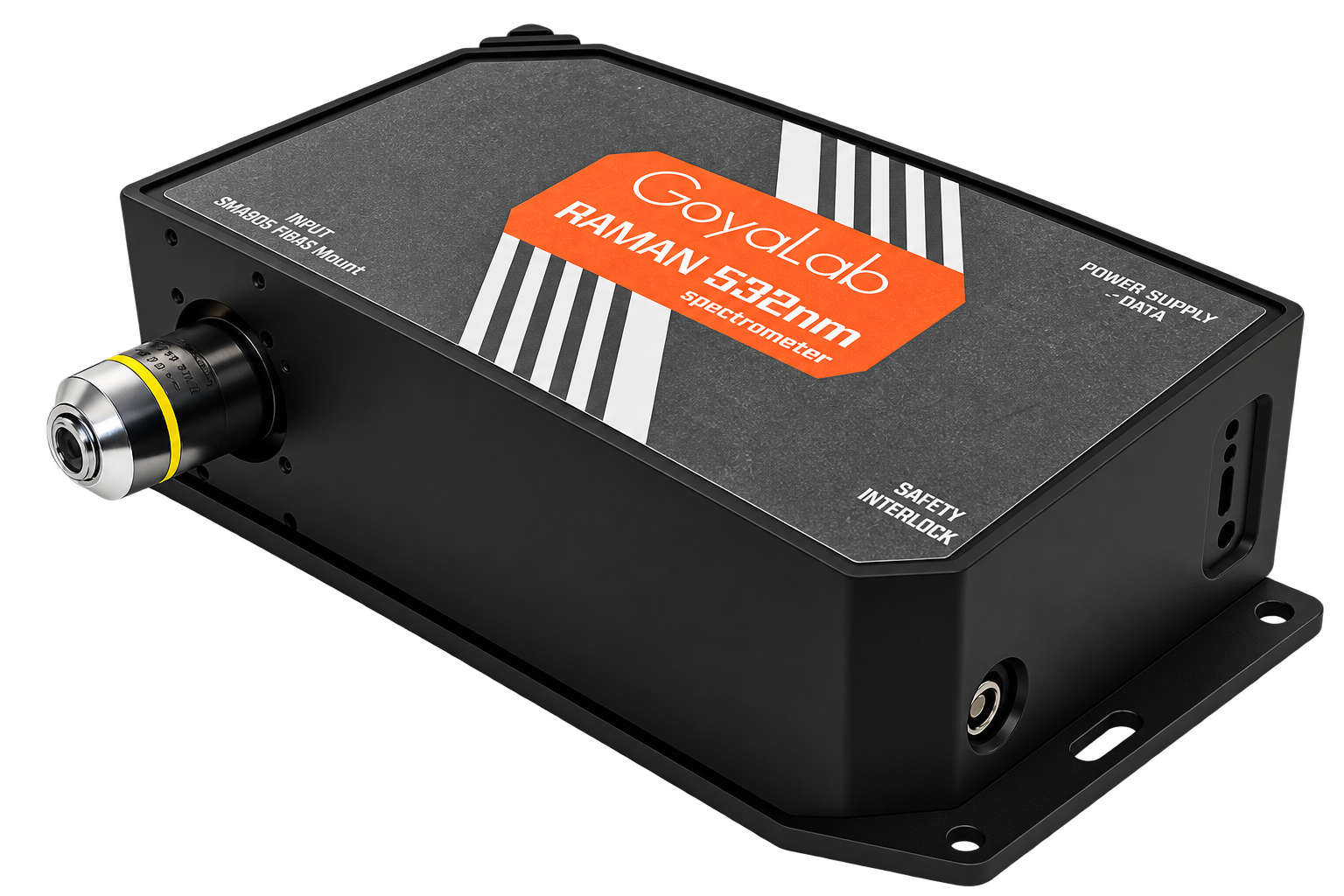
The GoyaLab 532 nm Raman spectrometer is a compact benchtop instrument designed for high-resolution vibrational characterization of advanced materials, minerals, and molecular structures. Thanks to the enhanced scattering efficiency at 532 nm and a high numerical aperture (NA 0.2), it delivers an exceptional signal-to-noise ratio over a very broad spectral window from 150 to 4,000 cm-1.
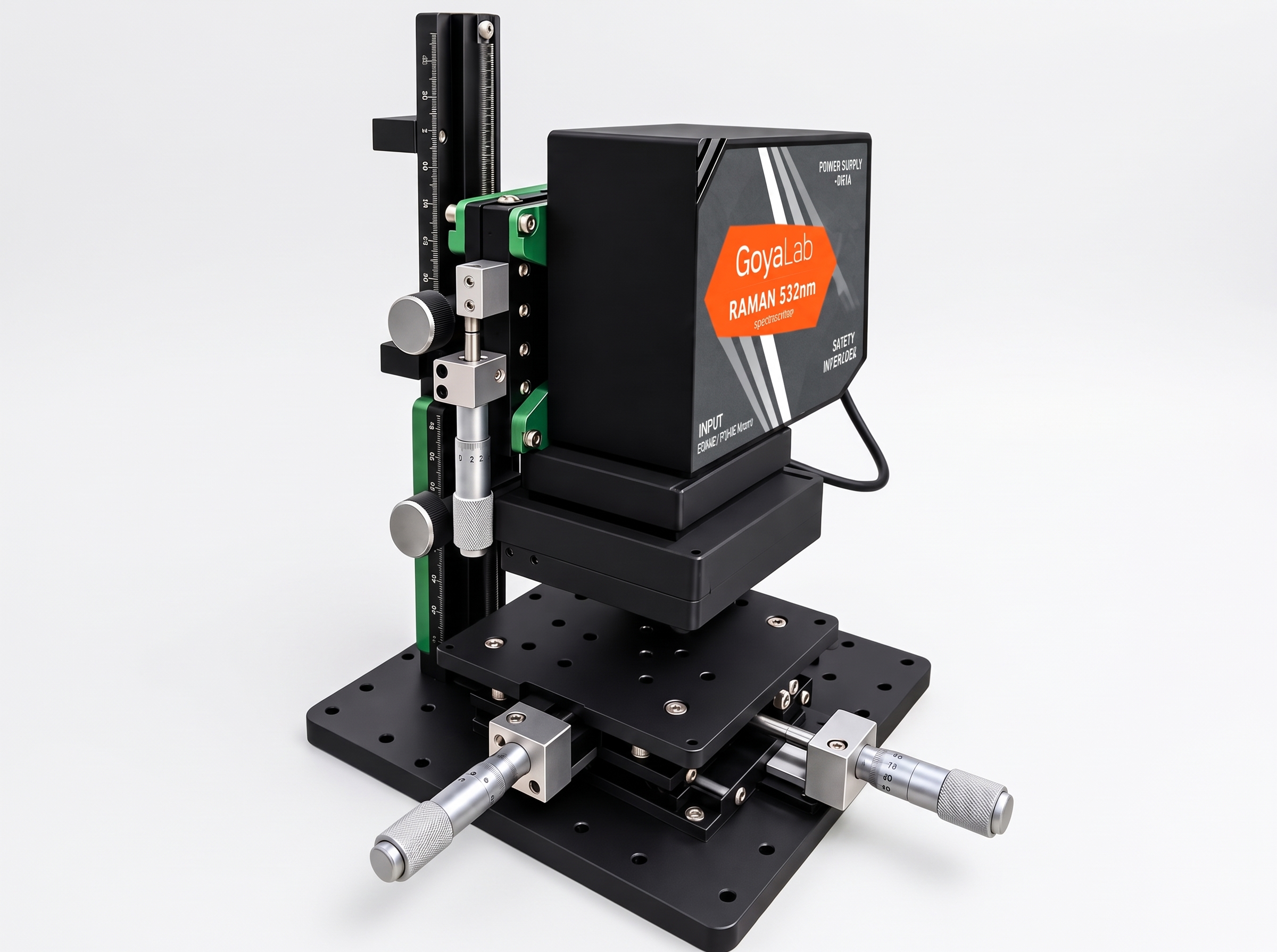
Highly versatile and scalable, this instrument adapts to any analytical context: mounted on a high-precision ergonomic “3D-Stand” for micro-spectroscopy with interchangeable objectives, equipped with a Class 1 secure vial holder enclosed compartment for liquids and powders, or deployed via a remote interlocked fiber probe.
Optical Architecture Highlights & Performance
- 532 nm Single-Mode excitation laser: Frequency-stabilized laser source delivering a maximum power of 80 mW. Power is adjustable from 10% to 100% in precise 1% steps to perfectly suit fragile or photosensitive samples.
- Wide Raman window & low-frequency cut-off: Ultra-steep Edge filter cutting at 150 cm-1, ideal for crystal lattice modes, extending up to 4,000 cm-1 to cover all C-H, O-H, and N-H bonds.
- 8 cm-1 spectral resolution: Optical resolution measured at the mid-point of the spectral shift range, ensuring clear separation of fine vibrational bands.
- Choice of high-sensitivity sensors:
- Standard: Monochrome Sony IMX676 2D CMOS sensor (2.0 µm pixels, high dynamic range, very low readout noise).
- Research / Ultra-low signal option: Scientific water-cooled sCMOS sensor, designed for very long exposure times without dark current accumulation.
- Certified Laser Safety:
- Class 1 (Total Eye Safety): Operate without mandatory safety goggles thanks to the hardware interlock system integrated into the enclosed “3D-Stand” or the vial holder module.
- Class 3B: Open configuration without the 3D-Stand for direct integration onto optical benches or custom setups.
- Auto-Calibration with provided standards: Built-in automatic calibration procedure within SpectroLab using the characteristic peaks of Sulfur or Silicon (520.7 cm-1), provided as standard solid samples and in borosilicate vials.
Modular Sampling & Micro-Positioning
- “3D-Stand” Analytical Stand:
- Fine micrometric movement along the horizontal X-Y axes.
- Combined vertical Z adjustment: rapid millimetric approach and micrometric control for micron-level laser focusing.
- Interchangeable Microscopy Objectives:
- Standard: MPLAN 10x objective mounted by default (typical laser spot ~3 µm).
- Micro-Focusing Options: 40x and 60x objectives (laser spot down to ~1 µm) to target microscopic inclusions, monolayers, or heterogeneous interfaces.
- Targeting system & contextual camera option: Retractable optical slider with a beam splitter, compatible with an optional color video camera to image the sample surface and precisely visualize the laser impact point within SpectroLab.
- Secure vial holder module (Class 1): Compartment designed for standard borosilicate glass vials with a 10 mm inner diameter (liquid solutions, oils, suspensions, and powders).
- Remote fiber probe option: For in-situ measurements away from the stand, equipped with a hardware safety interlock loop.
Key Applications
Excitation at 532 nm generates maximum Raman scattering efficiency (∝ 1/λ4), making this instrument the tool of choice for analyzing crystal lattices and inorganic materials:
- Nanomaterials & Carbon structures:
- Graphene: Instant single-layer / multi-layer discrimination, quantification of defects and oxidation state via the D, G, and 2D bands.
- Carbon nanotubes (SWCNT / MWCNT): Diameter analysis via RBM (Radial Breathing Modes) and purity qualification.
- Amorphous carbons, Diamond & DLC coatings: Tracking the sp2/sp3 ratio and mapping residual mechanical stress.
- Precision Gemology & Mineralogy:
- Non-destructive authentication: Instant discrimination between natural, synthetic, or treated gems (HPHT/CVD synthetic diamonds, emeralds, corundum, spinels).
- Inclusion characterization: Micrometric identification of mineral micro-inclusions without sample preparation.
- Geology & petrography: Differentiation of polymorphs (silicates, carbonates, rutile/anatase titanium oxides).
- Higher education & Fundamental research:
- Practical lab benches for universities and engineering schools (molecular spectroscopy, solid-state physics, materials science).
- Total Class 1 safety for students and intuitive software operation without complex optomechanical adjustments.
- Polymers & Non-fluorescent technical materials:
- Rapid identification of pure polymers, resins, and elastomers.
- Monitoring of cross-linking rates and macromolecular orientation.
General Technical Specifications
| Parameter | Specification |
|---|---|
| Excitation laser wavelength | 532 nm (Single Mode) |
| Maximum laser power | 80 mW (adjustable from 10% to 100% in 1% steps) |
| Raman Shift spectral range | 150 – 4,000 cm-1 |
| Edge cut-off filter | 150 cm-1 |
| Spectral resolution (FWHM) | 8 cm-1 (at mid-point of spectral range) |
| Numerical Aperture (NA) | 0.2 |
| Standard optical sensor | Monochrome Sony 2D CMOS (IMX676) |
| Optional optical sensor | Scientific water-cooled sCMOS |
| Default mounted objective | MPLAN 10x (interchangeable to 40x and 60x) |
| Targeting & imaging system | Beam splitter slider, optional integrated color camera |
| “3D-Stand” base | Micrometric X-Y movement, millimetric and micrometric Z adjustment |
| Vial holder module | Standard borosilicate format Ø 10 mm inner diameter with Class 1 safety |
| Laser safety classification | Class 1 (on 3D-Stand or vial holder) / Class 3B (without 3D-Stand/vial holder) |
| Connectivity | USB High-Speed & hardware interlock management |
SpectroLab data processing & Spectral libraries
- SpectroLab Software (Included, free, unlimited license):
- Advanced Raman mathematical processing: Cosmic ray removal (despiking), noise filtering (denoising, Savitzky-Golay), and automatic baseline correction (asymmetric algorithms AsPLS, polynomial baseline).
- Guided Auto-calibration: One-click automatic adjustment and validation of spectra using the Silicon (520.7 cm-1) or Sulfur reference peak.
- Universal exports: Open formats (.spc, .txt, .xlsx, .csv) compatible with your existing data pipelines.
- Reference library compatibility: Seamless interfacing with ST Japan spectral databases and the Wiley KnowItAll® suite for instant identification of unknown substances and minerals via similarity search.
- Expert / Capture Chemometrics suite (Option): Dedicated modules for Principal Component Analysis (PCA) for automated sample classification, geological origin discrimination, or compliance checking via spectral clustering.
💡 Configure Your Custom 532 nm Raman Bench
Would you like a demonstration on your nanomaterial, gemstone, or mineral samples, or to evaluate the water-cooled sCMOS sensor option?
👉 Contact our Raman spectroscopy specialists
Interested in this product ? Request a quote
Our GoSpectro and GemSpectr apps are available on the stores:


Application
The applications are unlimited. Today our expertise is focused in particular on the following areas


Optical Filter Characterization
Optical Transmission Measurement of Polymers and Crystals

Translucent Liquid Colorimetry: Transmission Measurement & Industry Scales
Greenhouse PAR Measurement: Control the Light Your Crops Actually Use
LED Light Source Characterization: Spectral Metrology at Your Fingertips

Liquid Analysis in Transmission: Absorbance, OD & Beer-Lambert Law

Education – Research

Advanced Gemology & Optical Metrology

Security Spectroscopy: Advanced Authentication & Traceability