T_Trace UV/Vis: High-Speed Multichannel Process Spectrometer
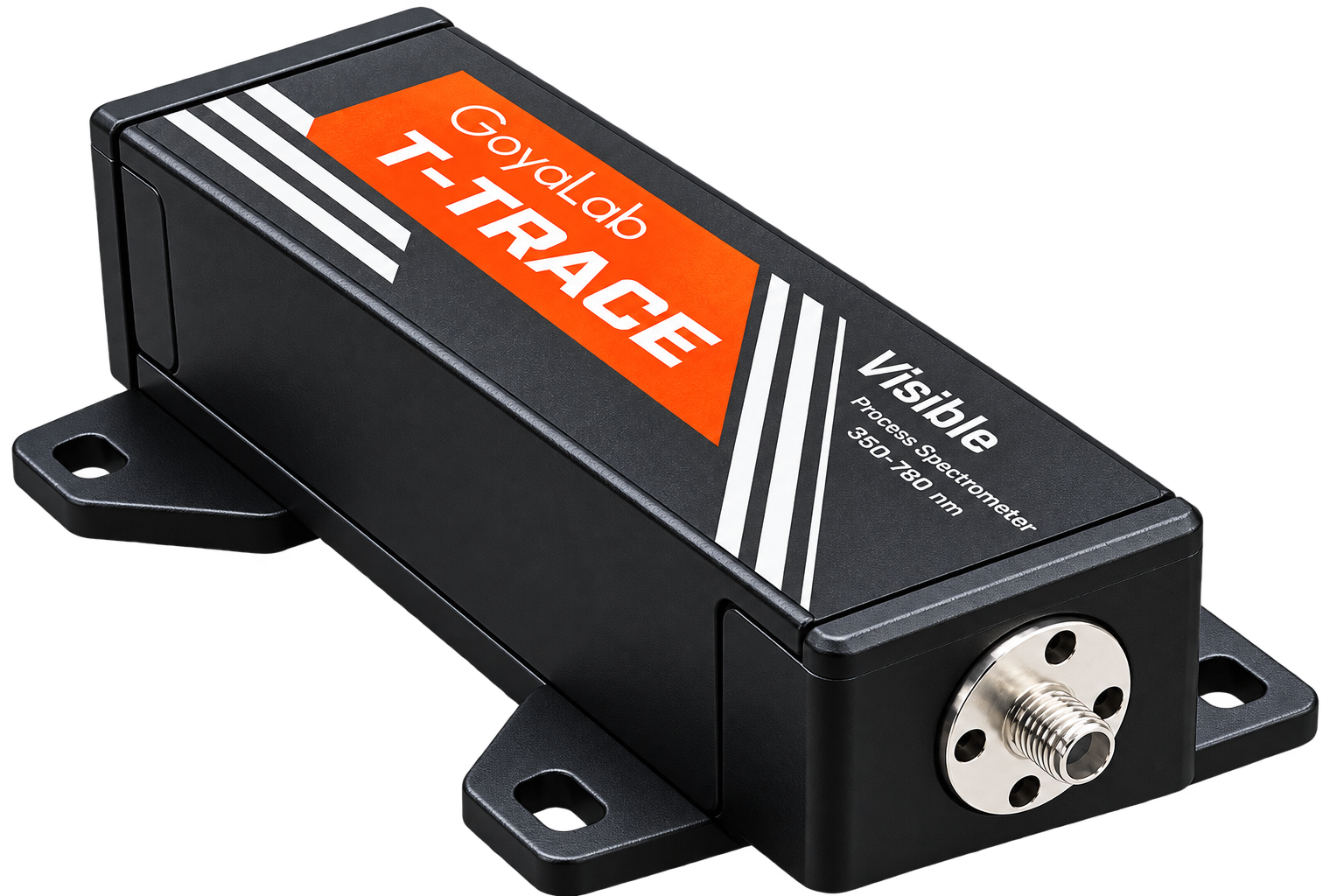
The T_Trace UV/Vis is a fiber-coupled industrial spectrometer designed for continuous in-line and on-line control. Built on a transmission optical architecture based on a proprietary GoyaLab grism, it combines a high-sensitivity 2D CMOS sensor with a large entrance slit (3 mm high) to analyze 1 to 8 optical channels simultaneously, with no mechanical multiplexing and no compromise on timing synchronization.
Powered directly over USB 3 or through PoE (Power over Ethernet) in GigE, the T_Trace UV/Vis transfers all raw spectra to your industrial PCs or plant supervisors for full traceability and real-time reaction monitoring.
Key strengths of the optical & industrial architecture
- True parallel multichannel (1 to 8 channels): the 3 mm slit simultaneously projects up to 8 distinct diffraction beams onto the 2D sensor. The 8 spectra are captured at exactly the same instant through the hardware trigger input.
- Configurable entrance slits: standard 25 µm slit for maximum resolution (< 1.5 nm), replaceable on request at order time with 70 µm, 100 µm, 150 µm or 200 µm to maximize light throughput on absorbing or low-signal media.
- Individual factory calibration: each fiber channel has its own wavelength calibration stored in memory, adjustable and verifiable at any time with the free SpectroLab software.
- Flexible fiber connections:
- Spectrometer input: standard SMA port for the single-channel version; high-density FC/APC connector for 2 to 8 channel configurations (micrometric fiber alignment done at the factory).
- Sample side: SMA or FC/PC terminations of your choice, mounted on optical collimators if needed to optimize beams in transmission or reflection.
- Universal measurement modes: transmission grating optimized for transmittance, absorbance, reflectance, fluorescence and Raman.
- Rugged IP54 housing & heat dissipation: anodized aluminum chassis designed for conductive heat dissipation through the base plate. It must be mounted on a conductive metal support (machine frame, steel or aluminum plate).
Industrial applications & use cases
With its 380 – 780 nm spectral coverage, fine resolution (< 1.5 nm) and synchronous multichannel capability, the T_Trace UV/Vis meets the requirements of the most demanding production environments:
- Fine chemicals, pharmaceuticals and biotechnology:
- Parallel reactor monitoring: simultaneous tracking of reaction kinetics in 8 separate tanks or fermenters with a single instrument.
- Purification and filtration: in-line detection of elution fronts by UV/Vis absorbance on industrial chromatography columns.
- Fast kinetics: real-time analysis of precipitation, crystallization and polymerization reactions thanks to high acquisition rates.
- Food and beverages:
- Continuous colorimetry and compliance: direct spectrophotometric color control (CIELAB indices, turbidity) on syrups, beers, oils, juices or sauces.
- Clean-in-place (CIP) optimization: transmittance measurement of rinse effluents to shorten cycles and reduce water and detergent consumption.
- Flow anomaly detection: immediate identification of a color change or an accidental batch mix on a bottling line.
- Surface treatment and industrial chemistry:
- Chemical bath control: continuous assay of active species and contaminants in pickling, phosphating and electroplating baths.
- Reflectance measurement on moving webs: monitoring of the appearance and gloss of polymer films, flat glass or metals in continuous motion, using the synchronous trigger and collimated heads.
- High-speed sorting lines and multi-point metrology:
- Ultra-fast optical sorting: single-channel mode up to 1,800 spectra/s for high-speed unit sorting lines.
- Spatial profiling of a part: the 8 fibers can be spread across a product web to check the uniformity of a coating or coloring across its full width.
Optical & electronic specifications
| Parameter | Specification |
|---|---|
| Spectral range | 380 – 780 nm (UV/Vis) |
| Optical sensor | Sony monochrome 2D CMOS (IMX676) |
| Slit width (on request) | 25 µm (standard), 70 µm, 100 µm, 150 µm or 200 µm |
| Slit height | 3 mm (dedicated to multichannel) |
| Optical resolution (FWHM) | < 1.5 nm (with standard 25 µm slit) |
| Number of optical channels | 1 to 8 simultaneous channels (no optomechanical multiplexing) |
| Spectrometer optical input | SMA (single channel) / FC/APC (2 to 8 channels) |
| Measurement-side optical connection | SMA or FC/PC of your choice (compatible with collimator terminations) |
| Communication interfaces | USB 3.0 High-Speed or GigE (industrial connector) |
| Power supply | Self-powered via USB 3 or PoE (Power over Ethernet via GigE) |
| External triggering | Hardware trigger input (simultaneous channel synchronization) |
| External lighting control | Control of 1 to 4 T_Light sources via the external T_link box |
| Protection rating | IP54 (anodized aluminum housing) |
| Mounting & thermal | Dissipation through the base plate (conductive steel/aluminum support required) |
Acquisition rates (measurement frequencies)
Vertical windowing (ROI) on the CMOS sensor adapts the readout rate to the number of active channels (typical sampling of 50 lines per fiber):
| Configuration | Sensor readout mode | Maximum theoretical rate* | Cumulative rate |
|---|---|---|---|
| Single channel (1 channel) | 50 active lines | up to 1,800 spectra/s | 1,800 spectra/s |
| Multichannel (8 channels) | Full slit (~1,400 lines) | up to 80 acquisitions/s | 640 spectra/s |
* Maximum rate measured for an integration time Tint ≤ 0.5 ms. Under real process conditions, the measurement frequency depends on the light flux and follows F = 1 / max(Tint, Treadout).
In-line integration & measurement accessories
GoyaLab designs and sizes the entire optical sampling chain to adapt the T_Trace UV/Vis to your pipes, tanks or conveyors:
- Optical collimators: mounted on the measurement fiber terminations to generate calibrated parallel beams for non-contact reflection or transmission benches.
- Transmission immersion probes: for continuous monitoring inside chemical reactors, bioreactors or formulation tanks.
- Flow cells: integration in a bypass or directly on the flow line for clear liquids or reagents.
- T_Light illumination & T_link extension box:
- The T_Trace controls 1 to 4 T_Light sources (each with 2 separate emission channels, e.g. UV + broadband visible).
- Interfacing is provided by the external T_link box, which acts as an input/output (I/O) extender slaved to the spectrometer and supplies the 24 V power required by the lighting modules.
Software ecosystem & data processing
- SpectroLab (included, free, with no license limit): full instrument control, reference spectra management (dark / white), real-time monitoring and instant export to standard formats (.xlsx, .txt, .spc).
- Complete Python API: native integration into your proprietary test benches, software controllers or AI pipelines with just a few lines of code.
- Expert / Capture chemometrics suite: spectral data ready for building qualitative (PCA) and quantitative (PLS) models.
- SaaS deployment in a dedicated secure cloud.
- Dedicated server option (on-premise): can be deployed on your company’s local server infrastructure to meet strict industrial data security and sovereignty requirements.
💡 Integrate the T_Trace UV/Vis into your process line
Need specific optical sizing (flow cells, probes, dedicated slit) or a feasibility study on your samples?
👉 Contact our application engineers
Interested in this product ? Request a quote
Our GoSpectro and GemSpectr apps are available on the stores:


Application
The applications are unlimited. Today our expertise is focused in particular on the following areas


Optical Filter Characterization
Optical Transmission Measurement of Polymers and Crystals

Translucent Liquid Colorimetry: Transmission Measurement & Industry Scales
Greenhouse PAR Measurement: Control the Light Your Crops Actually Use
LED Light Source Characterization: Spectral Metrology at Your Fingertips

Liquid Analysis in Transmission: Absorbance, OD & Beer-Lambert Law

Education – Research

Advanced Gemology & Optical Metrology

Security Spectroscopy: Advanced Authentication & Traceability